
Construction & Demolition Debris Rules in Dakota County, MN
Before you start a remodel or a tear-off in Lakeville, understand how the debris has to leave - because the curbside carts won't take it, Minnesota's rules limit burning, and it has to reach a licensed facility.
In this guide
- The rule that catches people out
- Why you can't just burn it
- Where the debris actually goes
- What has to be kept separate
- The simplest compliant path
If you're planning a remodel, a tear-off or a demolition anywhere in Lakeville or the wider Dakota County area, the debris side is worth understanding before the first wall comes down. Minnesota has clear rules about where construction and demolition (C&D) debris can go, and the local systems that handle household trash aren't built to take it. Getting it right keeps a project moving and keeps you clear of a compliance problem.
Here's how C&D debris actually has to leave a property here, in plain terms.
The rule that catches people out
The thing most homeowners don't expect is that Lakeville' curbside pickup - run by your subscription hauler under the city's contract - handles household garbage and recycling, but not construction and demolition debris. A remodel, a roof, or a tear-out produces exactly what that service won't take.
That's not a Lakeville quirk - it's how Minnesota regulates C&D. The state's environmental authority, the Minnesota Pollution Control Agency (MPCA) requires that construction and demolition waste go to a licensed transfer station or landfill, whether it came from a commercial building or a house.
So the moment your project's debris outgrows a few household bags, you need a plan to get it to a licensed facility - and that's what a roll-off dumpster is for.
Why you can't just burn it
Burning the debris isn't a shortcut here. Minnesota's burning rules prohibit burning construction and demolition material statewide - painted or treated wood, drywall, shingles and the like release exactly the kind of smoke the rules are written to prevent.
On top of that, Lakeville is far too large for the yard-waste burning exception that applies in very small communities. Minnesota law bans burning household trash and building debris outright and statewide, with fines that can reach a thousand dollars, and even burning brush or yard waste in Lakeville requires an open-burning permit from the Lakeville Fire Department.
A contained recreational fire with clean, seasoned firewood is a different thing and generally allowed - but it is not a disposal method for a renovation. For anything past that, the debris has to be hauled.
Where the debris actually goes
Licensed C&D disposal in the Lakeville area runs through a transfer station or landfill. The SKB Rosemount landfill on Courthouse Boulevard is right here in the city and accepts both trash and construction debris; the SKB Rosemount landfill is the other main option.
Both charge a tipping fee by weight at the scale, which is why a roll-off with a set weight allowance is the predictable way to handle it - you know the disposal cost up front rather than paying per pickup-truck trip.
A hauler who runs that route daily clears far more per pull and keeps the paperwork Minnesota expects on a regulated load.
What has to be kept separate
Not everything in a debris pile belongs in the same stream. Clean concrete, brick and rock - no timber, no tangled rebar, no rubbish - count as clean fill and can be crushed and reused as base material rather than buried, which keeps your cost down.
Clean metal and cardboard come out for recycling. Reusable cabinets, doors, fixtures and appliances can go to the Habitat ReStore rather than the landfill. And household hazardous waste - paint, solvents, oil - stays out of the container entirely, bound for the Dakota County collection site in Eagan.
Sorting at the source isn't just tidy; it's cheaper, because clean loads cost less to handle than contaminated mixed ones.
The simplest compliant path
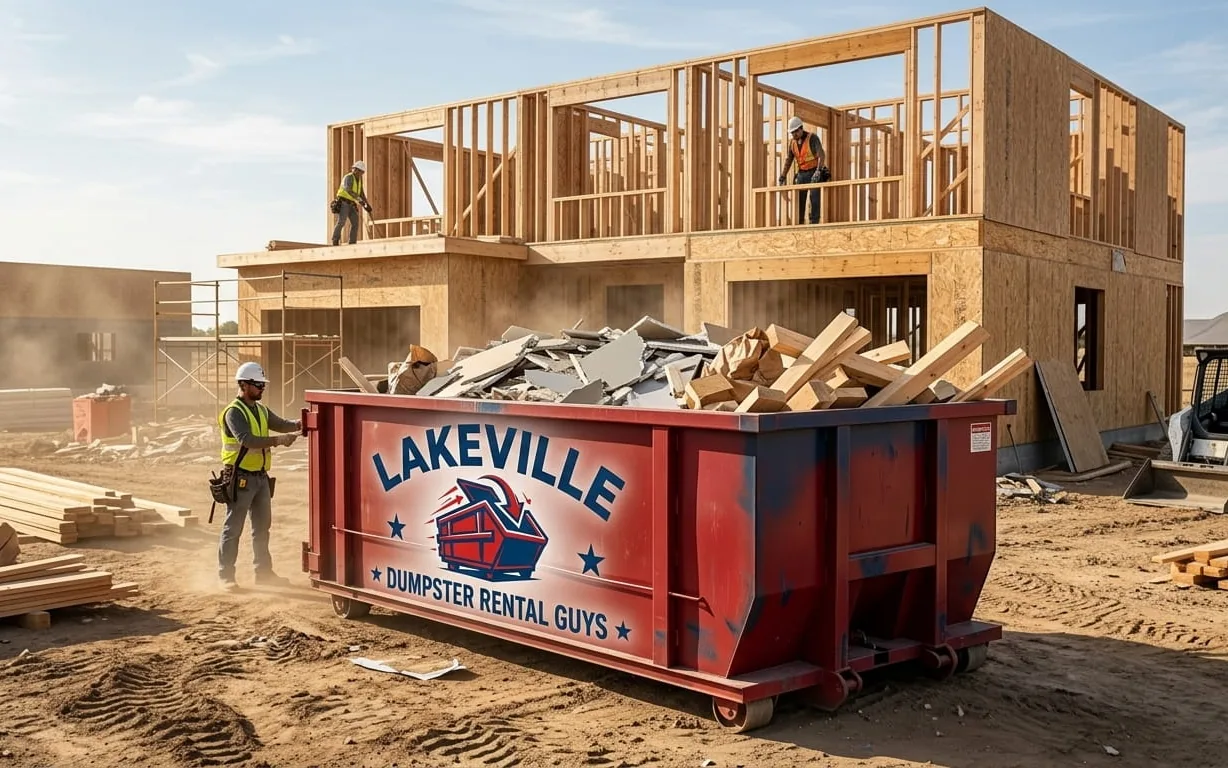
For most projects, the clean route is a single roll-off on the driveway. You load it at your pace, we size the weight allowance to the material, and we haul it tarped to a licensed transfer station or landfill - keeping clean fill, metal and reusable materials diverted along the way.
That one decision takes the disposal question off your plate: no dozen trips to the transfer station, no burn you're not allowed to do, no debris left where it shouldn't be. It's the difference between a job that clears cleanly and one that turns into a headache.
If you're not sure what size you need or what can go in, call (952) 314-3942 and describe the project - we'll size it and tell you plainly what belongs in the box and what needs another route.
Book a container in Lakeville
One flat rate covering delivery, seven days, pickup and disposal.
(952) 314-3942Questions readers ask about this
Can I put construction debris out with Lakeville curbside pickup?
No. The curbside carts from your subscription hauler take household garbage and recycling, not construction and demolition debris. That goes to a licensed transfer station or landfill, and a roll-off is the practical way to get it there.
Do I need to separate concrete from the rest?
It helps. Clean concrete, brick and rock count as clean fill and can be crushed and reused rather than landfilled, which lowers your cost. Keep it separate from timber, drywall and general debris from the start.
Is a permit needed to dispose of C&D debris?
Not to dispose of it - the licensed facility handles that. A permit only comes up if a container has to sit on the street or public right-of-way, which is arranged with the City of Lakeville.